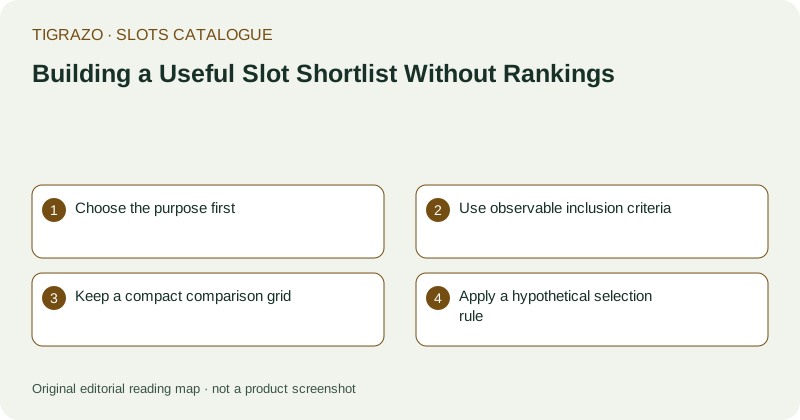
Choose the purpose first
Decide what the shortlist is meant to clarify. A reader studying evaluation methods might want one line-based example, one ways-based example and one cluster-based example. Someone comparing information quality might focus on complete rule panels and clear version identifiers. These purposes require different selections. A list becomes less useful when it mixes visual preference, mathematics and technical accessibility without saying which dimension matters.
Use observable inclusion criteria
Good criteria can be checked: an explicit award method, a readable stake unit, documented feature rules or an available configuration statement. Vague criteria such as exciting or generous require interpretation and should not masquerade as facts. If a field is absent, record it as missing. Do not assign a favourable value simply because an entry looks polished or uses familiar artwork.
Keep a compact comparison grid
| Criterion | Record |
|---|---|
| Format | Verified evaluation method |
| Rules | Available, incomplete or unclear |
| Features | Named mechanics and qualifiers |
| Unknowns | Questions still unresolved |
This grid does not generate a score. It exposes differences and omissions. Two entries can remain on the list for different reasons, with neither declared the overall winner. That is often the more accurate result when dimensions cannot be reduced to one common unit.
Apply a hypothetical selection rule
Suppose a catalogue has twenty entries, but the reading task is to examine persistent-symbol mechanics. Keep entries whose rules explicitly describe persistence and its reset boundary. Exclude entries that merely use a vague sticky-feature label until more information is available. The result is a better research shortlist, not a claim that excluded games are inferior or that included games have better financial outcomes.
Set a stopping point for browsing
A shortlist should reduce cognitive load rather than create an endless search for a perfect game. Set a small number of entries and a defined reading question. Once the criteria are represented, additional browsing may add little. There is no need to convert the shortlist into paid play, and no missing item needs to be tested through wagering simply to complete a comparison.
- State the reading purpose.
- Use checkable fields.
- Separate unknowns from negative findings.
- Keep dimensions visible instead of inventing scores.
- Stop when the comparison question is answered.
The result is a transparent index that can be revised when better information appears.
Keep removal criteria as explicit as inclusion criteria. An entry may leave the shortlist because its documentation is unavailable, not because it failed a quality test. Recording that reason preserves the distinction and makes later reconsideration straightforward when the missing information becomes available.