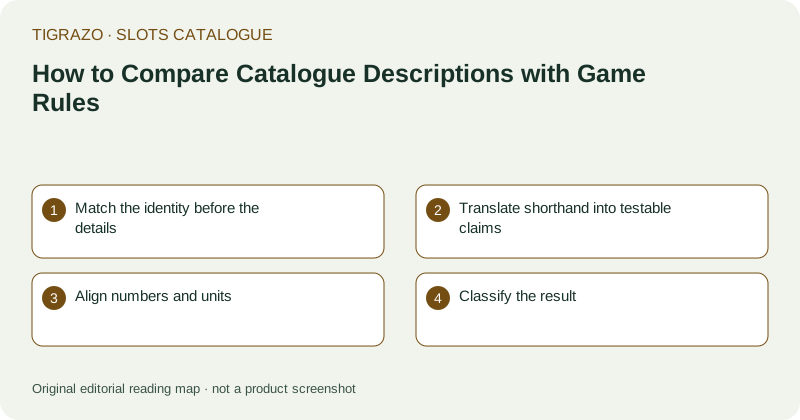
Match the identity before the details
Confirm that the catalogue description and rule panel refer to the same title, edition and configuration. Similar names or shared artwork are not enough. If a version identifier is unavailable, record that limit. A discrepancy in RTP may reflect multiple configurations rather than a simple transcription error. Matching identity first prevents a careful comparison from being built on two different objects.
Translate shorthand into testable claims
A phrase such as expanding feature is too broad to check without clarification. Rewrite it as a precise statement: the display gains additional active rows after a specified trigger, for example. Then locate the corresponding rule. This does not mean rewriting the game to fit the catalogue. It means exposing the actual assertion so that missing conditions and unsupported implications become visible.
Align numbers and units
Compare total-stake multipliers with total-stake multipliers, not line-stake amounts. Check whether a maximum applies per evaluation, per round or across a feature. In a hypothetical example, a card showing a twenty-times award and rules showing twenty times line stake are not equivalent to twenty times total stake in a multiline game. The number can be copied correctly while its meaning is misrepresented.
Classify the result
| Finding | Meaning |
|---|---|
| Accurate | The summary preserves the relevant condition. |
| Incomplete | A material qualifier is absent. |
| Inconsistent | The statements conflict in matched context. |
| Unresolved | Identity or evidence is insufficient. |
These categories are more useful than treating every omission as false. A short card cannot contain every rule, but it should not leave out a qualifier that reverses the ordinary meaning of its claim.
Preserve evidence and correct narrowly
Record the wording, the relevant rule section, the date and any visible version details. A correction should address the specific field rather than replace the whole description with a speculative verdict. If the problem is a missing trigger condition, add that condition. If the configuration is unknown, remove an unsupported numerical claim or mark it unresolved.
Do not use paid rounds to resolve a documentation question. A short outcome sample cannot reliably establish an omitted probability or confirm the scope of a maximum award. The strongest comparison stays anchored in the rules and clearly distinguishes documented facts from information the catalogue has not established.
Check whether the summary uses absolute language where the rules use conditions. Words such as always, every and unlimited deserve particular scrutiny. Replacing an unconditional claim with its documented trigger or boundary can repair a significant misunderstanding without making the card much longer.