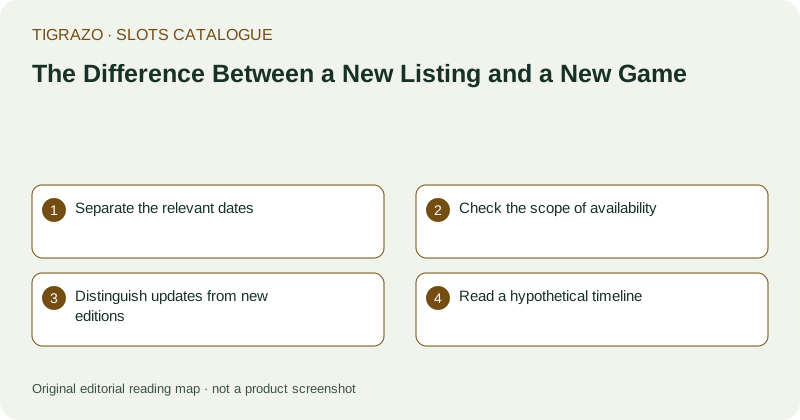
Separate the relevant dates
A game can have an original release date, a catalogue addition date and a later update date. Those dates answer different questions. A title added to a collection this week might have existed elsewhere for years. Conversely, a recently released title may appear in a catalogue only after a delay. Without a named date field, a new badge should not be treated as evidence of original publication.
Check the scope of availability
Availability can vary by location, account context or distribution arrangement. A new entry in one catalogue does not establish a worldwide launch. A description should say newly listed when that is the verified fact. It should reserve newly released for cases where release information actually supports the claim. This is an editorial precision issue, not a reason to invent a broader launch history.
Distinguish updates from new editions
A visual refresh, technical build or translated rule panel may update an existing title without creating a new game. A separately named edition can also reuse substantial elements while changing particular mechanics. Catalogue treatment should follow documented identity and scope. Neither changed artwork nor a familiar feature name alone settles whether an entry is a revision, a separate edition or a duplicate listing.
Read a hypothetical timeline
Imagine a title first released in March, added to a particular catalogue in September and given a technical update in November. A November card marked new could refer to the update, but it would be misleading to call the original game a November release without qualification. Three explicit fields would solve the ambiguity: original release, listing added and last revised. Unknown dates should remain unknown rather than being replaced by today's date.
Use freshness labels responsibly
- Ask what event the label describes.
- Look for a date and a defined period.
- Distinguish a collection-specific event from a wider release.
- Check whether identity or only presentation changed.
- Do not infer quality or improved mathematics from recency.
A recent listing can be useful for readers revisiting a collection because it highlights material they may not have seen. That practical benefit does not require a claim that the underlying game is new everywhere.
Freshness is a navigation dimension, not a performance score. A new badge says nothing by itself about expected return, technical stability, accessibility or the completeness of a rule panel. Those remain separate fields requiring their own evidence.
An archive of listing changes can clarify the label, but only if it records real events consistently. A page refresh date is not a substitute for a release date. Readers should not have to infer product history from routine edits to catalogue copy.