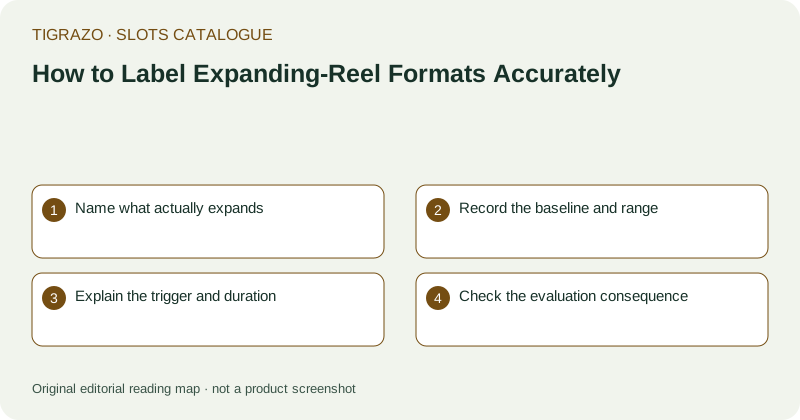
Name what actually expands
Reel expansion changes the active display structure, usually by adding visible positions. Symbol expansion changes the area occupied by a symbol within a structure that may remain unchanged. These are different mechanics even when both create a larger-looking image. A catalogue should not call an expanding wild an expanding-reel format unless the active reel layout itself also changes under the documented rules.
Record the baseline and range
A useful description identifies the ordinary reel height and any documented expanded state. If columns vary independently, a single rectangular measurement may be misleading. State whether the layout grows uniformly or whether separate reels have different heights. A hypothetical game beginning with three rows and sometimes adding two has a different specification from a game that starts at five rows and removes positions later.
Explain the trigger and duration
Expansion may follow a symbol, a collected count, a feature entry or a stage within a sequence. It may last for one evaluation, the rest of a paid round or an entire feature. These time boundaries matter as much as the largest display size. A thumbnail showing the expanded state cannot establish how often that state appears or how long the additional positions remain active.
Check the evaluation consequence
Extra positions do not automatically translate into a simple increase in payable ways. The game may use lines, clusters or a variable ways calculation. In a hypothetical ways model using one position choice per reel, heights of three, three and four give thirty-six possible position combinations. That arithmetic describes the stated model only; it does not show that every arrangement pays or that expected return rises when the display changes.
Write a restrained catalogue label
- State the ordinary layout.
- Name the event that changes it.
- Describe the maximum documented expansion.
- Identify when the expanded state resets.
- Keep award evaluation as a separate field.
A suitable label might describe a variable-height format rather than promise more winning opportunities. The latter wording risks confusing an increased count of possible arrangements with a quantified improvement in outcomes.
Expanded displays can make information denser on smaller screens, so readability is another independent consideration. That is an interface question, not a mathematical verdict. Catalogue categories are strongest when they preserve these distinctions: geometry, duration, evaluation and usability should remain separate dimensions rather than collapsing into one exciting but vague feature claim.
Also check whether newly visible positions are immediately eligible for ordinary awards. Some displays reveal decorative space before an active state begins. The useful catalogue fact is the activation rule, not merely that the screen becomes taller or shows more artwork during animation.