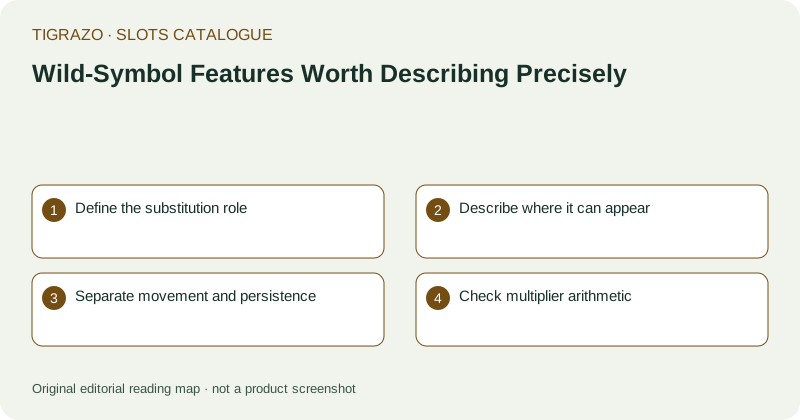
Define the substitution role
A wild commonly substitutes for specified ordinary symbols when evaluating an award. That does not mean it substitutes for every special symbol. Scatters, bonus symbols and jackpot symbols may be excluded. Some wilds also have their own awards, while others do not. A catalogue card should avoid universal wording such as replaces anything unless the rules clearly support that statement without important exceptions.
Describe where it can appear
Wilds may be limited to certain reels, feature modes or symbol positions. An illustration showing a full screen of wild artwork may depict an unusual feature state rather than the ordinary game. Record the appearance condition separately from the substitution function. Otherwise a reader may assume that a feature-only symbol can appear in every paid round or that it has the same effect wherever it lands.
Separate movement and persistence
A moving wild changes position according to a rule. A sticky wild remains in place for a defined interval. An expanding wild occupies additional positions under stated conditions. These behaviours can combine, but the words are not interchangeable. The useful details are the movement direction, the duration of persistence, the extent of expansion and the event that ends the effect. A broad enhanced-wild label hides all four.
Check multiplier arithmetic
When wilds carry multipliers, the combination rule matters. In a hypothetical example, multipliers of two and three could combine additively to five or multiplicatively to six, depending on the published mechanic. Applied to a base award of four units, those alternatives produce twenty or twenty-four units. Neither calculation should be assumed from two numbered symbols alone. The game may also restrict which awards receive the resulting multiplier.
Use a feature specification
- Substitutes for which symbols?
- Appears in which positions and modes?
- Moves, expands or persists under what conditions?
- Carries any multiplier, and how does it combine?
- Resets or disappears at which boundary?
This specification supports meaningful comparison between catalogue entries. Two games may both carry a sticky-wild label but retain symbols for different durations, making their actual processes distinct.
None of these labels establishes how frequently a wild appears or how much return it contributes. Those are probability and mathematical-model questions. Describe behaviour precisely, record unknown frequencies honestly, and avoid turning a visually elaborate wild into an unsupported claim of greater generosity or a recommendation to play.
Artwork can obscure the distinction between one enlarged wild and several independently evaluated wild positions. Where that distinction affects awards, the rules should settle it. Catalogue illustrations are useful for recognition, but they should not be treated as a substitute for symbol-counting instructions.