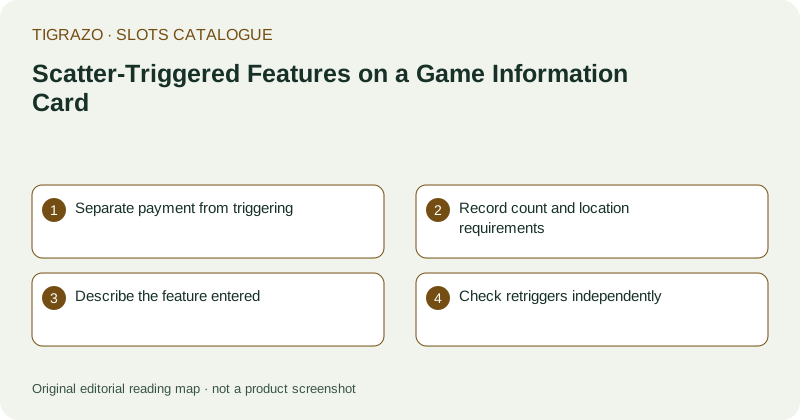
Separate payment from triggering
Some scatters pay according to their count regardless of ordinary line routes. Others trigger additional rounds without a separate scatter award. A single symbol type can also do both. Catalogue wording should distinguish these possibilities. Saying scatter feature tells a reader very little unless the card makes clear whether it describes a symbol award, entry to another mode or a combination of those functions.
Record count and location requirements
A trigger may require a specified number of scatters anywhere, on designated reels, or within eligible positions. The phrase anywhere should not be added casually. A hypothetical game could require three scatter-bearing reels rather than any three visible scatter symbols. In that case, two scatters on one reel would not necessarily count as two qualifying reels. The precise counting rule belongs in the underlying information.
Describe the feature entered
A card can name the resulting mode and a concise verified mechanic, such as a fixed initial allocation of additional rounds. It should not imply that every allocation remains fixed if retriggers, collected extensions or maximum-award conditions can alter the sequence. Entry conditions and in-feature rules are separate fields. Keeping them separate makes a short card more informative without filling it with promotional adjectives.
Check retriggers independently
A symbol that triggers a feature in ordinary play may behave differently inside that feature. It might award more rounds, add a multiplier, or cease to appear. A retrigger can have a different threshold from initial entry. For a hypothetical illustration, three symbols might grant eight rounds initially, while two symbols grant three extra rounds only within the feature. Those conditions must not be merged into one general trigger statement.
Keep frequency claims out of shorthand
- What does the scatter do?
- How are qualifying symbols counted?
- Where can they count?
- What mode or award follows?
- What changes after entry?
Neither a low trigger count nor a prominent symbol design establishes a high feature frequency. Probabilities depend on the actual outcome model, not the visual size of the icon or the length of its animation. Unless a frequency is explicitly documented for the relevant version, the catalogue should leave it unknown.
A clear scatter description explains conditions without predicting when they will be met. It also avoids the suggestion that a long absence makes the next trigger due. Browse by documented mechanics, not by imagined progress toward an independent event.
When several special symbols look similar, a card should use their exact rule labels rather than a broad bonus-symbol category. Distinguishing scatters from collectors or feature-only tokens prevents a visually convenient summary from suggesting that all special symbols count toward the same trigger.