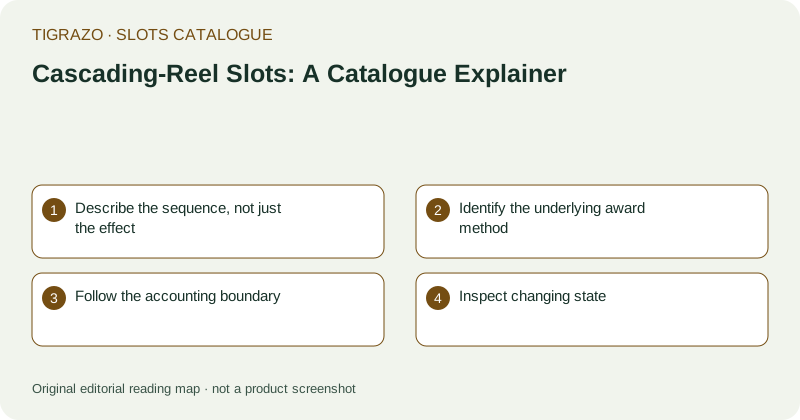
Describe the sequence, not just the effect
Words such as cascade, tumble and avalanche may refer to similar-looking processes without guaranteeing identical rules. A useful description says what initiates removal, which symbols disappear and how replacements arrive. Some games remove only symbols involved in awards; others have additional removal mechanics. The visual effect of falling symbols is not sufficient to establish the exact process.
Identify the underlying award method
Cascades can accompany lines, ways or connected groups. The catalogue should therefore separate the sequence label from the evaluation label. A reader who filters for cascading games has selected a type of progression, not necessarily a shared way of counting wins. That distinction also prevents misleading comparisons between a line-based cascade and a cluster-based cascade whose awards follow very different rules.
Follow the accounting boundary
A single paid round may produce several successive evaluations without an additional stake being deducted for each one. The actual rules and transaction record determine that boundary. In a hypothetical sequence, a one-unit stake produces stage awards of two units, zero units and a final stop. The gross round award is two units, and the net change from that round is plus one unit. More animation stages do not automatically mean more paid wagers.
Inspect changing state
Multipliers can increase across cascades, remain fixed, or reset under specified conditions. Collected symbols and reel heights can also change. A catalogue label such as increasing multiplier is incomplete without the reset boundary. Does it reset after the paid round, after a feature, or after an evaluation without an award? Those differences are central mechanics, not minor details that can safely be inferred from the feature name.
Record the stopping rule
- What begins a cascade sequence?
- Which symbols are removed or moved?
- How are replacement outcomes evaluated?
- When do multipliers or collected states reset?
- What ends the round or triggers a maximum-award stop?
A sequence normally ends according to a rule, not because the animation has reached a visually satisfying length. Maximum-award conditions can also interrupt a feature, so the largest apparent sequence is not necessarily completed in every case.
For catalogue browsing, cascading is a clear and useful process label. It should not be promoted as proof of extra value, more favourable probabilities or a particular session pace. The number of visible stages and the mathematical return are different dimensions, and only the documented rules connect them.
A catalogue can also state whether intermediate awards are shown individually or as an accumulated round total, if documented. This is an information-display characteristic. It can help readers follow the sequence without implying that one display style changes the underlying return.