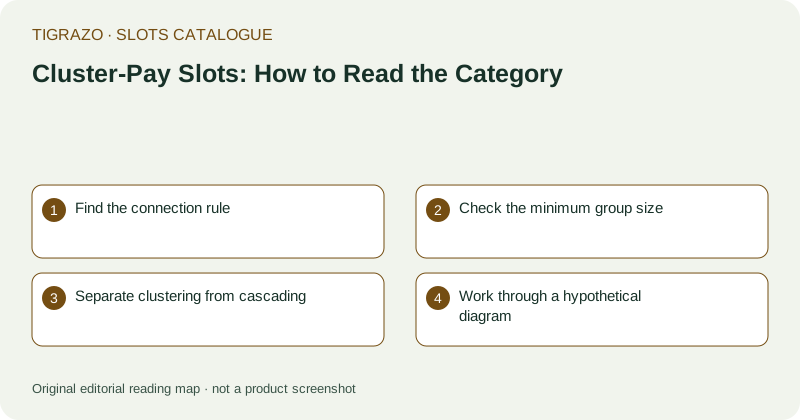
Find the connection rule
Matching symbols may need to touch horizontally or vertically, while diagonal contact may or may not count. The rules should also specify whether the group must be continuous. A picture of neighbouring symbols cannot settle those questions. A catalogue description should use language such as connected groups only when it can explain or clearly defer to the game's actual definition of connected.
Check the minimum group size
A cluster usually needs a minimum number of qualifying symbols before it pays. That threshold can differ between games or symbol types. The award may then increase with group size according to a schedule. Do not infer a smooth multiplier for every additional symbol unless the paytable says so. Some schedules use size bands, and some include a maximum counted size or a cap on the overall award.
Separate clustering from cascading
Cluster evaluation describes how an award is identified. Cascading describes what happens after certain symbols are removed and new symbols enter. The two mechanics often appear together, but neither implies the other. A game could evaluate clusters without repeated replacement, or use cascades with a different award method. A well-organised catalogue assigns separate labels so readers can distinguish evaluation from sequence behaviour.
Work through a hypothetical diagram
Imagine six matching symbols in one connected group and two matching symbols elsewhere. If the hypothetical rule requires five orthogonally connected symbols, the six-symbol group qualifies and the separate pair does not join it merely because the artwork matches. If the award table gives six symbols a multiplier of four times total stake, a two-unit stake produces an eight-unit gross award. Actual games may use different thresholds and units.
Read feature interactions separately
- Can wilds join more than one possible group?
- How are overlapping or neighbouring groups evaluated?
- Are symbols removed after an award?
- Does a multiplier reset between sequences?
- Do special symbols follow the same adjacency rule?
These questions prevent a broad cluster-pay label from concealing the mechanics most likely to change interpretation. A catalogue need not answer every question on the card, but its category should not imply an answer that has not been checked.
Cluster size and visual density are not measures of expected return. A large connected field can be visually striking without indicating the probability or value of future awards. Use the category to understand the evaluation structure, then read configuration-specific information for numerical claims.
If the rules include special clearing symbols, describe those separately from ordinary cluster formation. A symbol that removes neighbouring positions can alter the display without itself creating a payable group. Conflating removal with qualification makes the sequence harder, rather than easier, to understand.