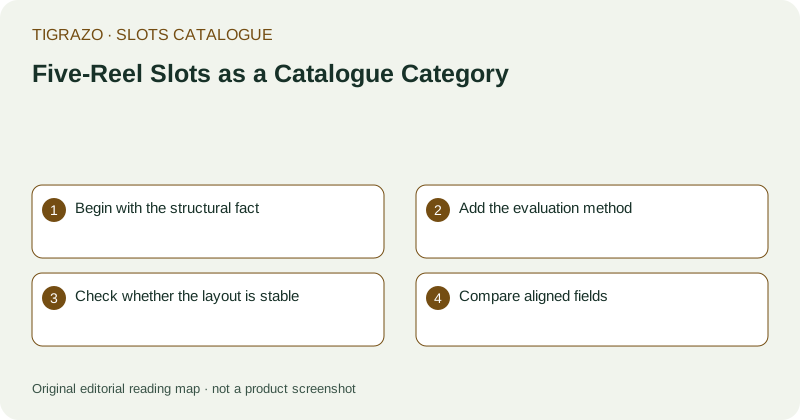
Begin with the structural fact
A five-reel label normally indicates five vertical reel positions in the principal display. It does not tell you how many symbol positions appear on each reel. A hypothetical five-by-three layout has fifteen visible positions, while a five-by-four layout has twenty. Both belong to the broad five-reel category. Neither position count establishes the number of payable combinations or the probability of receiving an award.
Add the evaluation method
Five-reel games can use fixed lines, selectable lines, ways or other methods. A catalogue should name that method separately from the reel count. If it lists a line count, the reader still needs to know whether all lines are included in the displayed stake. If it lists ways, the rules must explain consecutive-reel requirements and whether reel height changes the count during play.
Check whether the layout is stable
Some games retain five reels while changing the number of visible rows. Others use a separate feature display or additional symbol positions. A single screenshot may capture only one state. Precise catalogue language identifies the ordinary layout and notes any documented changes. It should not describe the largest possible display as though that arrangement appears on every ordinary spin.
Compare aligned fields
| Dimension | What to record |
|---|---|
| Reels | Five in the ordinary display |
| Rows | Fixed or variable visible height |
| Awards | Lines, ways or another stated method |
| Features | Named mechanics with rule qualifiers |
This small specification is more useful than adding a broad label such as modern. It supports like-for-like browsing while leaving room for hybrid structures that do not fit a simplistic category description.
Avoid importing performance assumptions
Five reels do not imply a particular RTP, volatility, maximum award or feature frequency. They also do not indicate that a game is more advanced or more generous than a smaller layout. A five-reel category is most helpful when the reader wants to understand visual organisation or locate a familiar structure, not when it becomes an unsupported quality ranking.
Before adding an entry to a shortlist, read its actual paytable and special-symbol rules. A clear catalogue can narrow the reading task, but it cannot replace it. The category should tell you where to look next, while the version-specific rules explain what the selected game actually does.
Check whether a separate upper reel or auxiliary position is counted in the category. Some catalogues describe the main display only. A clear note about supplementary positions avoids forcing a hybrid layout into an inaccurate rectangular specification simply to preserve a convenient filter.