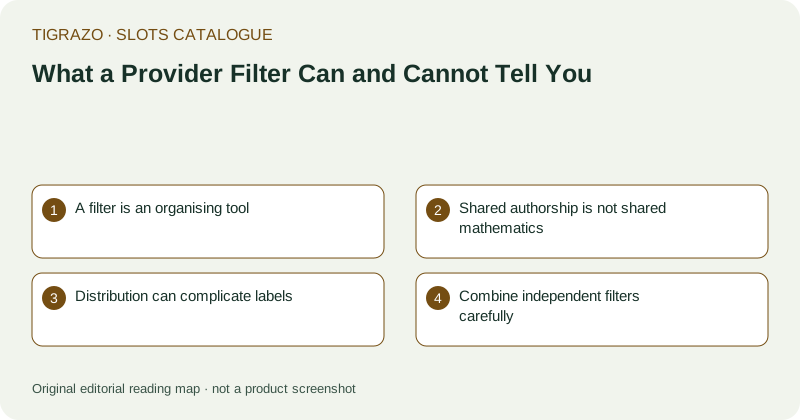
A filter is an organising tool
Provider filters reduce the number of visible entries by matching an attribution field. Their immediate value is practical: a reader can inspect a narrower collection without repeatedly searching names. The filter may reflect catalogue metadata rather than information independently checked inside every game. If precise authorship matters, compare the card attribution with the loaded game's own identifying information and any clear distribution labels.
Shared authorship is not shared mathematics
Games attributed to the same provider can have different award methods, RTP configurations, volatility profiles and feature structures. A familiar visual style does not remove those differences. Even a recurring feature name can have altered conditions between titles. The provider field is therefore a starting category, not a reliable proxy for expected return, award frequency or the complexity of the rulebook.
Distribution can complicate labels
A catalogue may distinguish a studio, a publisher and a distribution platform, or it may group entries under only one of those roles. Without a definition, two sites can use provider differently. That does not automatically mean one attribution is false. It means the field's meaning needs checking. Record the role that is actually stated instead of silently treating every company name as the original developer.
Combine independent filters carefully
A hypothetical search could combine a provider label with a cluster-pay category. The resulting set would contain entries matching both metadata fields, not necessarily every cluster-pay game created by that source. Incomplete tagging can exclude relevant entries. Conversely, a broad category may include hybrids. When the result looks unexpectedly narrow, inspect the filter definitions before concluding that the collection itself is small.
Keep an item-level checklist
- Confirm the specific title and attribution role.
- Check the ordinary award method.
- Read feature definitions independently.
- Match any numerical claims to the loaded configuration.
- Inspect device and accessibility information separately.
These checks prevent a provider's reputation or a familiar logo from doing the work of a specification. They also make browsing more transparent: an entry stays on a shortlist because of its documented characteristics, not because every game under a shared label is assumed to behave alike.
A provider filter can answer which catalogue entries carry a particular attribution. It cannot answer which game will return more in a session, whether a technical issue will occur on a device, or whether an undisclosed feature condition applies. Those require different information.
Sorting within a provider group can introduce another layer of meaning. Alphabetical order is transparent; featured order may follow undisclosed editorial or commercial choices. The position of an entry should not be interpreted as an independently established rating unless a method is supplied.