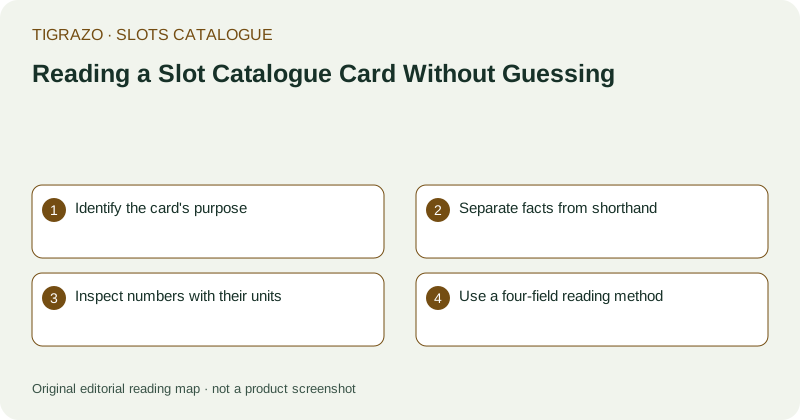
Identify the card's purpose
A catalogue card usually helps readers distinguish entries quickly. It may show a title, an illustration and several feature labels. Those fields support navigation, but they do not necessarily disclose the mathematical configuration, all award conditions or the date a listing was checked. Treat the card as a route to more detailed information. Its visual polish does not make an omitted field known.
Separate facts from shorthand
A reel count is a structural fact if it matches the game's documented layout. A term such as action-packed is an editorial description without a fixed measurement. A volatility label sits somewhere else: it may be a supplied category, but its scale and method still need clarification. Reading these as different kinds of information prevents a compact card from appearing more precise than it is.
Inspect numbers with their units
A maximum multiplier needs a stake basis. An RTP needs a configuration and scope. A ways count may refer to a particular reel state rather than every round. A hypothetical card saying ten thousand ways does not establish that all those combinations are simultaneously available under every condition. If the qualifier is missing, mark the information as incomplete instead of supplying an assumption that makes the card sound more impressive.
Use a four-field reading method
| Field | Useful question |
|---|---|
| Identity | Which title and version does this describe? |
| Format | How are ordinary awards evaluated? |
| Features | What does each label mean under the rules? |
| Provenance | Where did the information come from? |
This method keeps the browsing task manageable. It does not require every card to reproduce the full rulebook, but it does require the reader to recognise the boundary between a useful summary and a missing specification.
Resolve gaps before comparing
Imagine two hypothetical cards: one lists a five-reel layout and a scatter feature, while another lists cluster evaluation and expanding symbols. They cannot yet be compared on feature frequency, expected return or award limits. Their fields describe different dimensions. A fair comparison first aligns those dimensions and then checks the detailed rules for each.
Missing information is not evidence of a poor game, but it is a limit on what the catalogue can establish. Record the gap explicitly. A shortlist built on known fields is easier to revise than one built on guesses disguised as product facts.
Cards also need consistent missing-value treatment. A blank RTP field should not be read as zero, and an absent feature label should not prove the feature is impossible. Empty fields describe the catalogue's information state unless the listing explicitly says otherwise.